Homegrown Talent, Stronger Teams: The Case for Recruiting Within Lafayette's Business Community

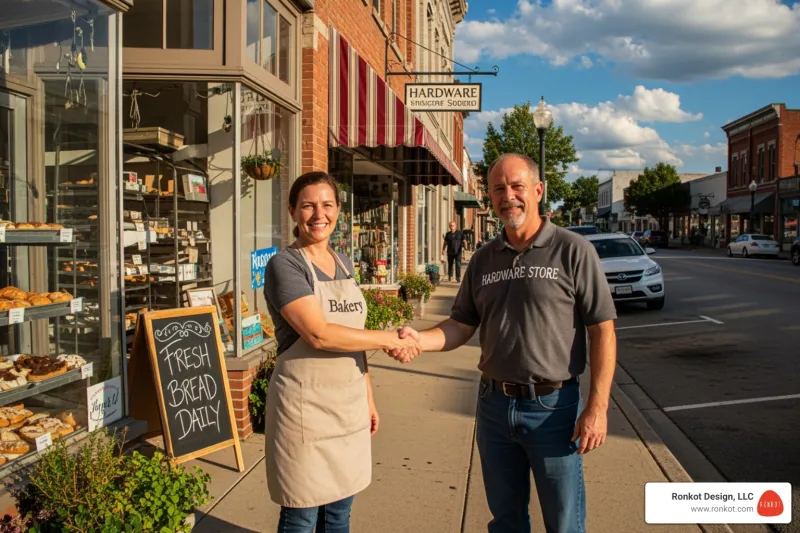
Photo: professional job interview handshake local business office, via img.freepik.com
When a Lafayette business posts an open position, the instinct is often to reach as far as possible—job boards with national reach, recruiting firms with coastal connections, perhaps even a relocation package designed to lure candidates from larger metro areas. The underlying assumption is that broader means better. But a growing number of Lafayette employers are quietly challenging that assumption, and the results are prompting a closer look at what the local talent market actually offers.
The professionals already embedded in Lafayette's business community bring something no out-of-state résumé can replicate: context. They understand the regional economy, recognize the names that matter, and have often built relationships across industries that took years to develop. Recruiting from within that network is not a compromise. For many organizations, it is a competitive advantage hiding in plain sight.
What "Local Talent" Actually Means in Lafayette
The phrase "local talent" can conjure images of recent graduates or candidates with limited experience. That framing does a disservice to what Lafayette's professional community actually contains. The region has produced and retained a substantial cohort of mid-career and senior professionals across sectors including healthcare administration, manufacturing operations, financial services, technology, and commercial real estate.
Many of these individuals have spent years—sometimes decades—accumulating expertise while simultaneously building the kind of reputational equity that only comes from sustained presence in a community. They have navigated Lafayette's regulatory environment, weathered its economic cycles, and cultivated relationships with local vendors, clients, and civic institutions. That accumulated knowledge does not appear on a LinkedIn profile summary, but its value inside an organization is considerable.
Furthermore, Lafayette's interconnected business ecosystem means that a professional transitioning from one local company to another often arrives with an informal understanding of industry norms, shared clients, and regional market behavior. The learning curve flattens considerably when the new hire already speaks the same professional language as the team they are joining.
The Hidden Costs of Recruiting Outside the Region
External recruiting carries real costs that are not always fully accounted for in hiring budgets. Relocation assistance, extended onboarding timelines, and the risk of cultural misalignment are among the most common. But there is a subtler cost as well: the time required for an out-of-market hire to build the local relationships that a Lafayette-based professional may already possess.
For roles that depend on community trust—business development, client relations, community affairs, or supplier management—this relationship deficit can take a year or more to close. During that period, the organization is operating at reduced effectiveness in precisely the areas where the new hire was brought in to add value. When a local candidate walks in with an existing network of relevant contacts, that gap simply does not exist.
Retention is another factor worth examining. Professionals who are already rooted in Lafayette—through family ties, civic involvement, or long-standing community connections—tend to stay. The lifestyle calculus that might prompt a relocated employee to pursue an opportunity elsewhere after two or three years rarely applies to someone who has built their life in the region. For employers who have experienced the disruption of turnover in key roles, that stability carries significant strategic weight.
Talent Recirculation as a Community Asset
There is a broader dimension to local hiring that extends beyond any individual organization's balance sheet. When experienced professionals move between Lafayette companies rather than departing for opportunities in larger cities, the regional economy retains both their income and their institutional knowledge. The skills they have developed, the client relationships they maintain, and the professional judgment they have honed remain assets within the community.
This recirculation effect strengthens the overall talent ecosystem. It signals to younger professionals entering the workforce that Lafayette offers genuine career mobility—that advancement is possible without leaving. Over time, that perception shapes whether ambitious professionals choose to plant roots here or treat the region as a temporary stop on the way to somewhere else.
Chambers of commerce and business networking organizations play a meaningful role in facilitating this dynamic. When professionals gather regularly through local events, peer groups, and industry forums, they develop the kind of visibility that makes internal recruiting feasible. An employer who attends Lafayette Junction events with regularity is not just networking for business development—they are also building an ongoing awareness of the talent available in their community.
Practical Approaches to Local-First Recruiting
Shifting toward a local-first hiring orientation does not require abandoning external searches entirely. It does, however, require a more deliberate approach to tapping into the networks that already exist within Lafayette's business community.
Several practices have proven effective for employers who have made this shift. Maintaining an active presence at local professional events creates natural visibility among potential future hires. Engaging with alumni networks from regional institutions and vocational programs surfaces candidates who have chosen to build their careers in Lafayette. Leveraging relationships with trusted peers in complementary industries can surface candidates who may not be actively searching but would consider the right opportunity.
Employee referral programs are particularly powerful in tight-knit professional communities. A current team member who has spent years in Lafayette's business environment likely knows multiple qualified candidates personally. Structuring referral incentives to reward successful long-term placements—not just initial hires—aligns those incentives with the organization's actual retention goals.
Finally, employers benefit from thinking about talent acquisition as an ongoing practice rather than a reactive one. The best local candidates are often not actively searching. Building relationships before a position opens—through mentorship, advisory roles, or simple professional engagement—positions an organization to move quickly and confidently when the need arises.
Investing in the Community That Invests in You
There is a reciprocal quality to local hiring that deserves acknowledgment. Lafayette's business community has, in various ways, supported the companies that operate within it—through local purchasing, civic partnership, and the shared infrastructure of a functioning regional economy. Prioritizing local talent is one concrete way that employers can reinvest in that community.
It is not sentimentality that makes this argument compelling. It is alignment. The professionals who have built their careers in Lafayette understand its rhythms in ways that are genuinely difficult to import. For employers who are serious about building durable, high-performing teams, that understanding is not a soft benefit. It is a strategic foundation.
The next time a position opens on your team, the most valuable candidate may already be someone you have seen at a local networking event, heard speak at a chamber luncheon, or worked alongside on a community initiative. The junction between your organization's needs and Lafayette's existing talent may be closer than your recruiting process currently assumes.