Presence, Productivity, and Purpose: How Lafayette Employers Are Reexamining the Remote Work Equation
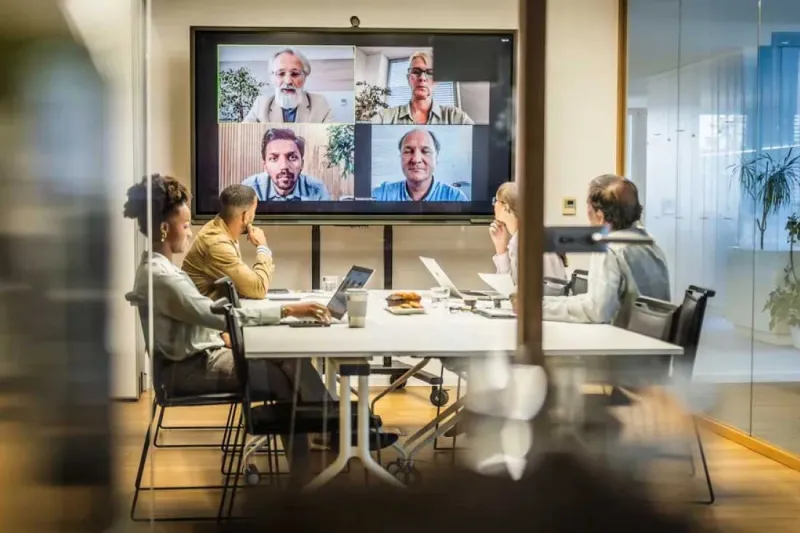
Photo: professional employee returning to office hybrid work meeting, via www.activtrak.com
When the pandemic forced offices to close, remote work was widely framed as a temporary inconvenience. Few anticipated that it would become a permanent fixture of the American workplace—or that, several years on, employers would still be struggling to measure its true cost.
In Lafayette, that reckoning is well underway. Across industries ranging from professional services and financial advising to light manufacturing and healthcare administration, local business leaders are revisiting the assumptions that underpinned their remote and hybrid arrangements. What many are finding challenges the narrative that distributed work is uniformly beneficial.
The Metrics That Don't Show Up on a Productivity Dashboard
The conventional case for remote work rests on productivity data. Surveys consistently show that employees report higher output when working from home, and absenteeism often declines. For a time, many Lafayette employers accepted these figures at face value.
But productivity metrics capture what workers produce—not how organizational knowledge moves through a company, how junior employees develop professional judgment, or how culture compounds over time. These are the dimensions where remote arrangements have proven most costly, and they are notoriously difficult to quantify.
Consider mentorship. In a traditional office environment, a great deal of professional development occurs informally—through overheard conversations, spontaneous problem-solving sessions, and the kind of low-stakes observation that allows newer employees to absorb how experienced colleagues handle difficult clients or unexpected setbacks. Remote work largely eliminates this ambient learning. The result, according to several Lafayette employers who spoke with Lafayette Junction, is a widening gap between senior staff and early-career employees who have never had the opportunity to learn by proximity.
One Lafayette-based accounting firm that transitioned to a fully remote model in 2020 reported noticing a measurable difference in the professional readiness of associates hired during that period compared to those onboarded before the shift. The firm has since moved to a structured hybrid schedule requiring in-office presence at least three days per week for staff in their first two years of employment.
Culture Drift: The Slow Erosion That's Hard to See Coming
Organizational culture is another casualty that tends to reveal itself gradually. In the short term, companies that pivot to remote work often retain the cultural momentum built before the transition. Employees share institutional values, understand unwritten norms, and maintain relationships forged in person. Over time, however, that momentum dissipates.
New hires join a company they have never physically inhabited. They form their impressions of the organization through video calls and messaging platforms—environments that compress communication and strip away much of the contextual richness that shapes how people understand their workplace. Without deliberate intervention, culture becomes harder to transmit and easier to dilute.
For Lafayette's small and mid-sized businesses—where culture is often a primary competitive differentiator in attracting and retaining talent—this erosion carries particular risk. A regional financial services firm that operates across multiple Lafayette-area offices has responded by designating one day per week as an all-hands in-office day, not for meetings or structured programming, but specifically to allow unscripted interaction. Leadership describes the initiative as a "culture maintenance" strategy rather than a productivity measure.
Which Industries Are Pulling Back—and Why
The return-to-office movement in Lafayette is not uniform. Industry context matters enormously, and the decisions local employers are making reflect the specific demands of their sectors.
Professional services firms—law offices, accounting practices, consulting agencies—have been among the most aggressive in restructuring remote arrangements. Client-facing roles, in particular, are being brought back to physical offices, with employers citing relationship quality and client confidence as primary drivers. In competitive markets where trust is a core product, the argument for visible, accessible professionals is difficult to dismiss.
Technology-adjacent companies and creative agencies have shown greater comfort with sustained hybrid models. These organizations tend to employ workers who are more self-directed, more accustomed to asynchronous communication, and whose output is more easily evaluated independently of where it is produced. For them, the flexibility premium remains a meaningful recruiting advantage in a tight labor market.
Healthcare administration and financial services occupy a middle ground. Regulatory considerations, data security requirements, and the complexity of compliance obligations often create practical barriers to full remote work, while the nature of the work itself may not demand constant in-person collaboration. Many Lafayette employers in these sectors have settled on structured hybrid arrangements that balance operational requirements with employee preferences.
Company Size as a Variable
Beyond industry, company size appears to be a meaningful predictor of remote work posture among Lafayette employers.
Smaller businesses—those with fewer than fifty employees—tend to place a higher premium on in-person presence. At this scale, every relationship within the organization is consequential, and the informal bonds between team members directly affect collaboration quality and collective problem-solving capacity. Owners and senior leaders at smaller Lafayette firms frequently describe remote work as a structural mismatch for their organizations, regardless of what productivity data might suggest.
Larger employers, by contrast, often have the infrastructure—dedicated HR functions, formal onboarding programs, structured performance management—to compensate for some of the developmental gaps that remote work creates. They are also more likely to have negotiated remote or hybrid arrangements as part of competitive compensation packages, making reversal politically and logistically complex.
What's Actually Driving the Decisions
For all the debate about productivity, culture, and mentorship, it would be misleading to suggest that Lafayette employers are making these decisions in a vacuum of pure organizational principle. Labor market dynamics play a significant role.
In sectors where talent is scarce and candidate leverage is high, flexibility remains a powerful retention and recruiting tool. Employers who mandate full-time in-office attendance without compelling justification risk losing workers to competitors willing to offer greater autonomy. The calculus is genuinely difficult, and most Lafayette business leaders acknowledge that there is no universally correct answer.
What is changing, however, is the quality of the conversation. Early in the remote work era, many employers accepted distributed arrangements without rigorous analysis of the tradeoffs. Today, the more thoughtful operators in Lafayette's business community are asking harder questions: What does our specific workforce need to develop? What does our culture require to sustain itself? What do our clients actually value?
Those questions do not always yield the same answers. But asking them with intention—rather than defaulting to either blanket mandates or uncritical flexibility—represents a more sophisticated approach to one of the defining workforce challenges of this decade.
Finding the Right Balance for Lafayette Businesses
The remote work debate is unlikely to be resolved by any single data point or policy framework. What Lafayette's most adaptive employers are demonstrating is that the most durable arrangements are those built around honest assessment rather than ideology.
For business owners and leaders navigating this terrain, the most productive starting point may be an internal audit: Where is your organization losing ground that doesn't show up in your productivity metrics? Where are your newest employees struggling to develop? Where is your culture weakest?
The answers will differ by company. But in a community as relationship-driven as Lafayette, the case for intentional, purposeful presence—whether full-time, hybrid, or structured around specific roles—is one that deserves serious consideration.